
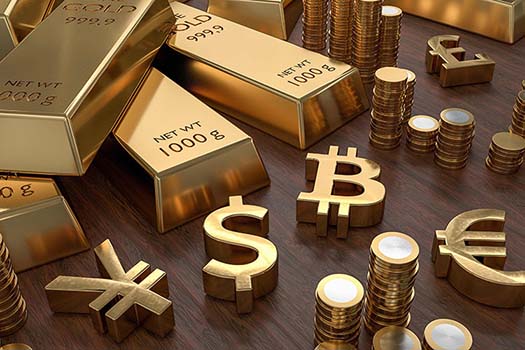
Dubai has spent decades earning its reputation as a global capital of gold — visible in the glittering shopfronts of the Gold Souk and the trading floors of DMCC. But the way people in the UAE actually buy, sell, and invest in gold has changed dramatically. What used to mean a trip to a jeweller now increasingly happens through an app, a trading account, or a tokenised digital platform — and that shift is reshaping the city’s entire precious metals ecosystem.
A City Built for Gold, Now Going Digital
Dubai’s credentials as a gold hub are not new. The city is home to more than 1,500 companies across its gold and precious metals ecosystem, with annual trade exceeding USD 186 billion. What’s changed is the infrastructure sitting behind that trade. The Dubai Gold & Commodities Exchange (DGCX), the Middle East’s largest digital marketplace for gold, has seen accelerating momentum — as of February 2026, the number of traded contracts on the exchange surpassed 2 million, with average daily volumes up 30% year-over-year. Gold futures activity was a particularly strong driver in 2025, with volumes surging more than 600% year-on-year, helping the exchange post nearly USD 47 billion in total contract value for the year.
This growth isn’t happening in isolation. At the Dubai Precious Metals Conference, held at Atlantis The Palm and drawing more than 1,000 industry leaders — the highest attendance in the event’s history — DMCC officially unveiled DMCC FinX, a new platform designed to unite financial institutions, fintech platforms, alternative lenders, digital asset innovators, and global trading houses within a single ecosystem. Speaking at the conference, the UAE’s Minister of State for Foreign Trade highlighted that tokenisation and blockchain are unlocking new levels of liquidity, transparency, and efficiency across global supply chains — positioning Dubai to lead the next chapter of the precious metals trade.
What “Online Gold Trading” Actually Means Today
Online gold trading in Dubai now spans a genuinely wide spectrum of products and platforms. At the simplest level, it lets a trader speculate on gold price movements through spot gold prices, gold futures, gold-related stocks, and gold ETFs — all executable from a phone or desktop rather than a trading floor. Regulated brokers such as Century Financial, overseen by the UAE’s Securities and Commodities Authority (SCA), offer dashboards with customisable charts, instant price alerts, and round-the-clock multilingual support.
Beyond speculative trading, a distinct and increasingly popular category has emerged: digital gold ownership. Platforms in this space allow investors to own fractional quantities of physical bullion, fully backed by allocated gold held in professional vaults, without the logistics or security burden of personal custody. Unlike gold ETFs or derivative contracts, digital gold platforms typically record ownership at the gram level, with holdings backed by real, allocated metal rather than a paper claim. ISA Bullion, operating under the DMCC umbrella, is one example — it allows purchases in increments as small as 0.1 grams, with real-time pricing and no withdrawal charge for in-person pickup. Mashreq Gold, meanwhile, lets UAE bank clients buy and sell investment-grade gold online through a dedicated Gold/Silver Edge Investment Account, with prices updated twice daily and instant conversion back to cash.
Underpinning much of this digital layer is DMCC Tradeflow, an online platform for registering ownership of commodities stored in UAE-based facilities. Since 2022, DMCC has partnered on tokenised gold initiatives where each physical bar tokenised into a digital asset is backed by a Tradeflow warrant — a structure designed to strengthen investor confidence in digital gold products by tying them directly to verifiable physical stock.
The Infrastructure Behind the Trend
None of this digital growth exists without serious physical backing. The DMCC Vault, owned by DMCC and operated by Brink’s Global Services, sits five levels below ground and below sea level in Jumeirah Lakes Towers, fortified with 24/7 surveillance and strict access controls. It offers insured storage and white-glove pickup services with no capacity limits, and is positioned deliberately close to major transport hubs and gold trade routes spanning Asia, Africa, and Europe. This kind of vaulting infrastructure is precisely what allows digital and tokenised gold products to credibly claim they’re backed by real, allocated metal rather than a purely paper promise.
On the retail side, Dubai has also just launched the Dubai Gold District in 2026 — a purpose-built commercial and retail district in Deira, developed by Ithra Dubai as part of the wider redevelopment of Old Dubai. The district, home to more than 1,000 stores, is designed to consolidate retail jewellery, bullion trading, wholesale activity, and investment-related services within a single hub. As part of this redevelopment, the “Gold Street” project was announced in January 2026, described as the world’s first purpose-built gold street, forming part of the historic Gold Souk area’s expansion. The development also includes six hotels and more than 1,000 guest rooms aimed at supporting the international traders and buyers the district hopes to draw in.
Why Gold Continues to Attract Investors
The appeal of gold trading in Dubai isn’t purely structural — it’s also driven by broader macroeconomic conditions. Gold prices have surged in recent years amid inflation concerns, rising geopolitical tensions, and continued central bank buying, particularly from China, India, Turkey, and several Middle Eastern nations. This sustained institutional demand has provided a meaningful price floor even through periods of volatility.
For many investors, gold is not viewed as a standalone investment but as part of a broader wealth-building strategy alongside equities, real estate, and other assets. Physical gold, in particular, continues to attract investors because it’s a tangible asset not directly dependent on the performance of a company, government, or financial institution — a distinction that matters more to some investors during periods of economic uncertainty.
Opportunities and Considerations Going Forward
For everyday investors weighing their options, the UAE market now genuinely spans the full spectrum — from walking into the Dubai Gold Souk or Gold & Diamond Park to compare prices in person, to opening a fully digital trading account backed by real-time pricing and vaulted storage. DMCC-accredited bullion dealers remain the preferred route for investment-grade bars and coins, offering transparent pricing and tighter spreads, while established retail chains like Malabar Gold, Joyalukkas, and Damas offer convenience, even if their bullion pricing is typically less competitive.
Whichever route an investor chooses, the fundamentals of responsible gold investing haven’t changed with the shift online: understanding the product, comparing costs and spreads, verifying purity and accreditation (999.9 fine gold from DMCC- or LBMA-recognised refiners is the market standard), and treating gold as part of a long-term diversification strategy rather than a short-term trade. Trading and investment products always carry risk, and past performance is never a guarantee of future returns — a caveat that applies as much to a slick new digital platform as it does to a traditional souk purchase.
As Dubai continues investing in both its physical gold infrastructure and its digital trading ecosystem, the city looks set to remain one of the world’s most closely watched gold markets — for traditional buyers and online traders alike.